From Idea to Online Store: My Shopify & Meta Ads Journey
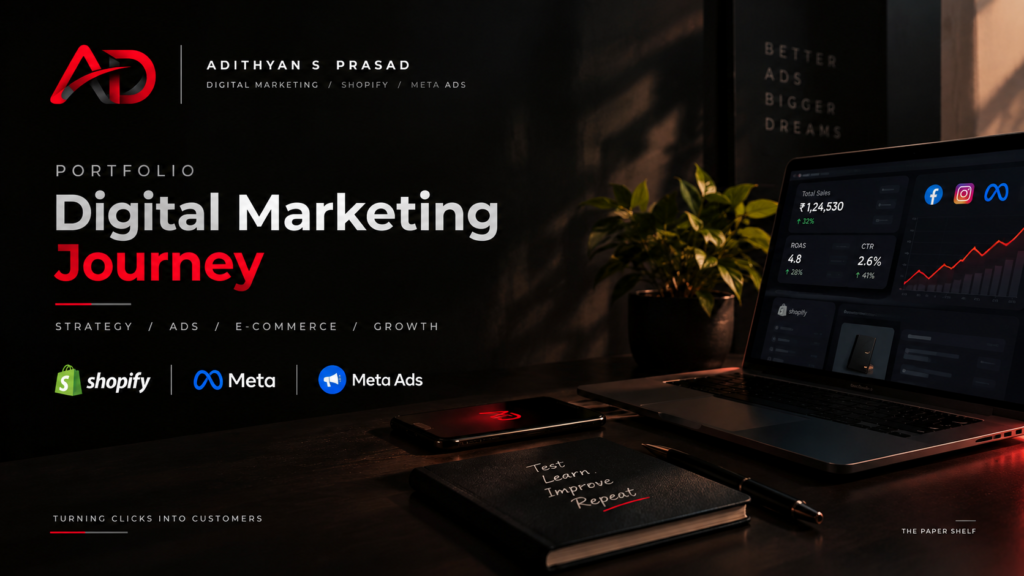
# From Idea to Online Store: My Shopify & Meta Ads Journey
### Building, Testing, Learning — The Story Behind The Paper Shelf
My journey into digital marketing started with a simple goal: **understanding how an online business actually works.**
Instead of only learning digital marketing through theory, I wanted to build something myself, experiment with different strategies, make mistakes, analyze the results, and continuously improve.
That’s how **The Paper Shelf** began.
The Paper Shelf became more than just an online store. It became my practical learning project where I explored **Shopify, Meta Ads, product marketing, website optimization, audience targeting, content creation, and e-commerce strategy.**
—
## Starting With Shopify
The first step was building the foundation of the business.
I chose **Shopify** because it gave me an opportunity to understand how an e-commerce website works from the ground up.
I worked on areas such as:
* Setting up the online store
* Creating product pages
* Writing product descriptions
* Organizing products and collections
* Designing the storefront
* Improving the customer journey
* Setting up essential store sections
* Understanding e-commerce conversion principles
Building the store helped me realize that creating a website is only one part of digital marketing.
The bigger challenge is getting the **right people to discover the product and take action.**
That led me to Meta Ads.
—
# Entering the World of Meta Ads
Once The Paper Shelf had an online presence, I wanted to understand how paid advertising could bring potential customers to the store.
I started exploring **Meta Ads** and learned how advertising on platforms such as Facebook and Instagram can be used to reach specific audiences.
My learning process involved understanding:
**Campaign → Ad Set → Audience → Creative → Landing Page → Conversion**
I began experimenting with different advertising ideas instead of simply creating an advertisement and hoping it would work.
—
## Understanding the Audience
One of the most important things I learned was that advertising isn’t simply about showing a product to as many people as possible.
It’s about understanding:
* Who could be interested in the product?
* What type of content attracts their attention?
* What problem or desire does the product connect with?
* What kind of message makes them curious?
* What makes someone click?
* What makes someone trust the store?
This changed the way I approached advertising.
Instead of thinking only about **”How do I sell this?”**, I started thinking:
**”Who am I trying to reach, and why would they care?”**
—
# Learning Creative Strategy
The creative became one of the most important parts of my Meta Ads journey.
I experimented with different approaches to presenting products, including:
* Product-focused visuals
* Promotional creatives
* Social-media-style content
* Different headlines
* Different calls to action
* Different visual compositions
* Different messaging styles
I learned that even when targeting is good, an advertisement can struggle if the creative doesn’t capture attention.
This taught me to look at advertising as a combination of **design + psychology + data.**
—
# Testing Instead of Guessing
One of the biggest lessons from working on The Paper Shelf was the importance of testing.
Instead of assuming that one advertisement would work, I started looking at different variables.
For example:
**Creative A vs Creative B**
**Headline A vs Headline B**
**Audience A vs Audience B**
**Product angle A vs Product angle B**
The purpose wasn’t simply to create more advertisements.
It was to learn **what actually performs better.**
This introduced me to the mindset of experimentation.
—
# Understanding Meta Ads Metrics
As I explored Meta Ads, I started paying more attention to the numbers behind the campaigns.
Some of the important metrics I learned to understand include:
### CPM
Understanding how much it costs to reach people.
### CTR
Understanding how many people interact with an advertisement after seeing it.
### CPC
Understanding the cost associated with getting clicks.
### Add to Cart
Understanding whether people who visit the store show purchase intent.
### Purchases
Understanding whether the advertising and website experience ultimately generate sales.
### ROAS
Understanding the relationship between advertising spend and revenue generated.
These numbers helped me move from simply **running ads** to actually **analyzing campaigns.**
—
# Connecting Meta Ads With Shopify
Another important part of my learning was understanding that Meta Ads and Shopify cannot be treated as completely separate systems.
An advertisement can perform well and still fail to generate results if the website experience isn’t good.
That made me look at the complete customer journey:
**Meta Ad**
↓
**Click**
↓
**Product Page**
↓
**Store Experience**
↓
**Add to Cart**
↓
**Checkout**
↓
**Purchase**
Every stage can affect the final result.
This helped me understand the importance of looking at digital marketing as a complete funnel rather than focusing on only one metric.
—
# Learning From Campaign Performance
Not every campaign or creative can be expected to work.
That became one of the most valuable lessons from my experience.
Some ideas perform differently from what I expected.
Instead of seeing that as failure, I started treating campaign performance as feedback.
If an advertisement wasn’t getting enough clicks, I could investigate the creative or messaging.
If people clicked but didn’t add products to their cart, I could look at the product page and offer.
If people added products but didn’t complete purchases, I could investigate the checkout experience and other possible friction points.
This changed my mindset from:
**”The ad didn’t work.”**
to:
**”What is the data telling me?”**
—
# The Paper Shelf as My Practical Digital Marketing Lab
The Paper Shelf gave me a place to apply what I was learning.
Through the project, I explored different areas of digital marketing:
**Shopify**
* Store creation
* Product pages
* Website structure
* Customer journey
**Meta Ads**
* Campaign setup
* Audience research
* Creative testing
* Performance analysis
**Content**
* Product presentation
* Ad creatives
* Copywriting
* Promotional messaging
**Analytics**
* Understanding campaign metrics
* Comparing results
* Identifying problems
* Learning from performance
**E-commerce**
* Product positioning
* Conversion thinking
* Customer experience
* Marketing funnels
—
# What I Learned
My journey with The Paper Shelf taught me that digital marketing is not about finding one magic strategy.
It’s a continuous process of:
**Research → Create → Launch → Measure → Analyze → Improve → Repeat**
Every campaign provides information.
Every click provides information.
Every customer interaction provides information.
And every mistake provides an opportunity to understand what can be improved.
—
# From Learning to Building
The Paper Shelf is an important part of my journey because it allowed me to move beyond simply learning digital marketing concepts.
I could actually apply them.
I learned how Shopify supports the e-commerce side of a business, while Meta Ads can help bring targeted traffic and potential customers to the store.
More importantly, I learned to think like a digital marketer:
**Don’t just create. Test.**
**Don’t just spend. Measure.**
**Don’t just look at clicks. Understand the customer journey.**
**Don’t assume. Analyze.**
—
# What I’m Exploring Next
My goal is to continue developing my skills in:
* Meta Ads
* Performance Marketing
* E-commerce Marketing
* Shopify
* Paid Social Advertising
* Conversion Optimization
* Analytics
* Content Strategy
* Digital Advertising
The Paper Shelf was the beginning of my practical journey.
I’m continuing to learn, experiment, and build my understanding of how digital marketing can turn an idea into a real online business.
—
## The Journey Continues
**The Paper Shelf started as an online store.**
For me, it became a practical digital marketing experience.
From building a Shopify store to exploring Meta Ads, testing creatives, studying campaign metrics, and understanding the customer journey, every step has helped me develop a stronger foundation in digital marketing.
This is not the end of the journey.
**It’s the beginning.**
### — Adithyan S Prasad
**Digital Marketing | Shopify | Meta Ads | E-commerce**